Saving throws
Combat · Damage to a monster · Saving-throw categories
In brief
A saving throw is one roll of a twenty-sided die, with no modifier, that must reach a threshold. Characters roll against traps, spells, monster attacks and some conditions; monsters roll against the damage of spells that allow one. The threshold falls as the level rises. It depends on the class group for a character, on the type's level for a monster, and on the category of the saving throw, which says what is being resisted; the categories and their uses are listed under saving-throw categories.
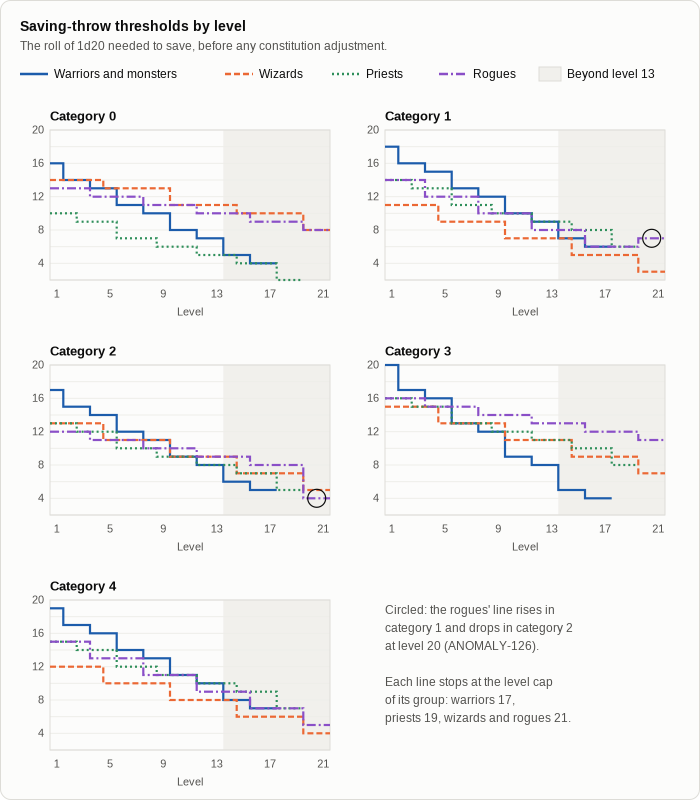
A character's saving throw
Traps, spells, monster attacks and some conditions let a character make a saving throw of a given category. One twenty-sided die, with no modifier, must reach a threshold:1
if category == SCRIPT_SAVING_THROW_NONE: no saving throw
group = saving-throw group of the character's class
L     = min(first level, cap of the group)
step  = L / divisor of the group                     # integer division
threshold = table of the group [category][step]
if the race qualifies for the category:
    threshold -= constitution adjustment
save if 1d20 >= threshold
Only the first base class counts: a multi-class character saves with the group and the level of the first class it lists, the same group as for its hit roll.
| Group | Classes | Cap | Divisor |
|---|---|---|---|
| Warriors | FIGHTER, RANGER, PALADIN, FIGHTER/CLERIC, FIGHTER/THIEF, FIGHTER/MAGE, FIGHTER/MAGE/THIEF, FIGHTER/CLERIC/MAGE, RANGER/CLERIC | 17 | 2 |
| Wizards | MAGE | 21 | 5 |
| Priests | CLERIC, CLERIC/THIEF, CLERIC/MAGE | 19 | 3 |
| Rogues | THIEF, THIEF/MAGE | 21 | 4 |
Warriors use the table that monsters use, by level (1, 2–3, … 16+). The thresholds of the other groups, by category and level:
Wizards:
| Category | 1–4 | 5–9 | 10–14 | 15–19 | 20+ |
|---|---|---|---|---|---|
| 0 | 14 | 13 | 11 | 10 | 8 |
| 1 | 11 | 9 | 7 | 5 | 3 |
| 2 | 13 | 11 | 9 | 7 | 5 |
| 3 | 15 | 13 | 11 | 9 | 7 |
| 4 | 12 | 10 | 8 | 6 | 4 |
Priests:
| Category | 1–2 | 3–5 | 6–8 | 9–11 | 12–14 | 15–17 | 18+ |
|---|---|---|---|---|---|---|---|
| 0 | 10 | 9 | 7 | 6 | 5 | 4 | 2 |
| 1 | 14 | 13 | 11 | 10 | 9 | 8 | 6 |
| 2 | 13 | 12 | 10 | 9 | 8 | 7 | 5 |
| 3 | 16 | 15 | 13 | 12 | 11 | 10 | 8 |
| 4 | 15 | 14 | 12 | 11 | 10 | 9 | 7 |
Rogues:
| Category | 1–3 | 4–7 | 8–11 | 12–15 | 16–19 | 20+ |
|---|---|---|---|---|---|---|
| 0 | 13 | 12 | 11 | 10 | 9 | 8 |
| 1 | 14 | 12 | 10 | 8 | 6 | 7 |
| 2 | 12 | 11 | 10 | 9 | 8 | 4 |
| 3 | 16 | 15 | 14 | 13 | 12 | 11 |
| 4 | 15 | 13 | 11 | 9 | 7 | 5 |
Experience raises a class to level 13 at most (see experience and levels), so the columns beyond 13 apply only to characters whose levels come from elsewhere.
The constitution adjustment
Dwarves and halflings lower the threshold in categories 0, 1 and 4, and gnomes in categories 1 and 4, by an amount read from their constitution:
| Constitution | 0–3 | 4–6 | 7–10 | 11–13 | 14–17 | 18–19 |
|---|---|---|---|---|---|---|
| Adjustment | 0 | 1 | 2 | 3 | 4 | 5 |
The table stops at 19; a higher score would read the bytes that follow it. This rule holds when a condition or a monster ray calls for the saving throw. Saving throws against damage test the race byte differently and give the adjustment to other characters; see the anomaly.
ANOMALY-126 — In the rogues' table, category 1 rises from 6 to 7 at levels
20 and above, and category 2 falls from 8 to 4 there; every other row of
the four tables decreases one step at a time. A faithful reimplementation
keeps both values. Experience never takes a class to level 20.1
A monster's saving throw
A monster saves when 1d20 reaches a threshold read from the warriors' table with its type's level, capped at 17 and halved:1
| Category | Level 0–1 | 2–3 | 4–5 | 6–7 | 8–9 | 10–11 | 12–13 | 14–15 | 16–17 |
|---|---|---|---|---|---|---|---|---|---|
| 0 | 16 | 14 | 13 | 11 | 10 | 8 | 7 | 5 | 4 |
| 1 | 18 | 16 | 15 | 13 | 12 | 10 | 9 | 7 | 6 |
| 2 | 17 | 15 | 14 | 12 | 11 | 9 | 8 | 6 | 5 |
| 3 | 20 | 17 | 16 | 13 | 12 | 9 | 8 | 5 | 4 |
| 4 | 19 | 17 | 16 | 14 | 13 | 11 | 10 | 8 | 7 |
Spells use category 4 when they allow a saving throw; weapons use category 5, which allows none. The categories are those of saving throws.
Sources
Locations refer to the game executable reference; comparative sources are listed in the technical references.