Formation
The party · Conditions · Flying weapons · Melee attacks
In brief
The party has six slots, which form three ranks of two (inferred from the tables that use them). A character's slot decides whether it can strike in melee (only the first two can), which monster attacks reach it, which projectiles hit it and which character a script affects. The player swaps two characters by choosing their names. A monster attacking in melee tries the characters in an order set by the side it attacks from.
Formation
The six party slots form three ranks of two (inferred from the tables that use them), from front to back: slots 0 and 1, then 2 and 3, then 4 and 5, each rank listed left then right. A character's slot decides:1
- Whether it can strike in melee. Only slots 0 and 1 can; a character in another slot who uses a melee weapon gets CAN'T REACH on its portrait. Thrown weapons, launchers and spells work from every slot, except the Cause Wounds spells, which also need the front ranks. See using a weapon.
- Which monster attacks reach it, below.
- Which projectiles hit it, below.
- Which character a script affects when the script names a slot rather
than the whole party; see
ScriptCharacterTarget.
Changing the formation
Clicking a character's name with the right mouse button, or pressing Shift with F1 to F6, and then choosing another character the same way swaps the two characters; between the two choices, the first one is marked "Swapping". Any character present in the party can be moved, even dead or unconscious. The whole record changes places, with its items, spells and effects; the character timers are set up again for the new slots, and the second character chosen becomes the selected one.2
While the game waits for the second choice, the six names are the only way to continue, and the rest of the interface does not respond. A press of either mouse button elsewhere on the character panel, or Escape, cancels the swap and removes the mark; see waiting for a character.2
Who a monster attacks
A monster attacks in melee when the block in front of it is the party's block and it stands in the half of its own block that faces the party; see melee attacks. It then chooses its target by the side it attacks from and the half of its block it stands in:3
order = attack_order(side: front, left, right or behind;
                     the monster's half of its block)
for each slot in order:                                # six slots
    if the slot is absent, dead or turned to stone: skip it
    if the character has SPELL_EFFECT_INVISIBILITY or
       SPELL_EFFECT_IMPROVED_INVISIBILITY and roll(1, 20) >= 5: skip it
    attack the character
    if the monster type lacks MONSTER_CAP_ATTACKS_ALL: stop
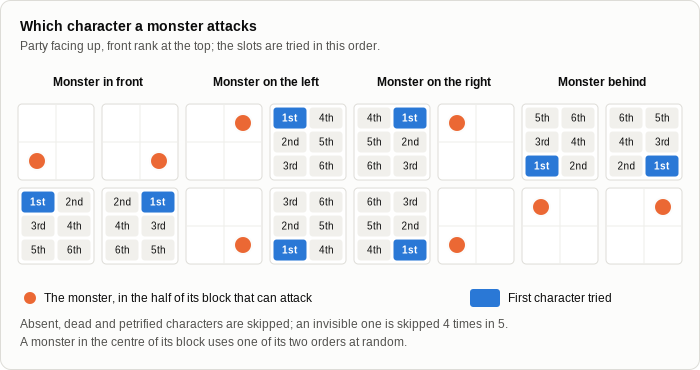
The monster thus attacks the nearest character on its side, and moves on to
the next one only when that character is gone, dead or turned to stone, or
escapes through invisibility.
Unconscious and paralyzed characters stay targets: a monster in front keeps
attacking an unconscious front character until it dies. Conditions do not
change the monster's hit roll, which,
because of a bug, reads the defense of
the character whose slot is the attack's number rather than the target's. A
monster standing in the centre of its block uses one of its two orders at
random. In the original levels, MONSTER_CAP_ATTACKS_ALL is set on two
monster types: the type of level 14 whose graphics are the frost giant's,
and the second form of the final opponent on level 16; such a monster
attacks every eligible character in turn.
Who a projectile hits
A projectile that reaches the party's block and affects the whole block hits every character present, each with its own damage roll. A single-target projectile hits one slot, chosen by the corner of the block where it arrives, seen from the party:4
| Corner | Slot hit |
|---|---|
| Front left | 0 |
| Front right | 1 |
| Back left | 2 |
| Back right | 3, or 5 on a 1d2 roll when the sixth slot holds a character (see the anomaly) |
There is no invisibility check. A dead or petrified character in the chosen slot stops the projectile without taking damage; an empty slot is not hit.
Only the back-right corner can send a single-target projectile to the third rank: the back-left corner always hits slot 2, so the character in slot 4 is never hit by a single-target projectile, while the one in slot 5 is hit half of the time the back-right corner is chosen. Whether this asymmetry is intended is unknown. A faithful reimplementation must keep slot 4 out of reach.
Sources
Locations refer to the game executable reference;
comparative sources are listed in the technical references.
The figures are drawn by make_party_figures.py.