Bestiary
Monsters · Level data (INF) · MonsterRuntime
In brief
The game has 29 monster images and 63 monster types. A type is a set of values shared by all the monsters of one number on a level: armour class, hit chance, level, hit dice, attacks, damage, flags and experience. There is no list of monsters for the whole game: the INF file of each level defines its own types, numbered from 0, in each of its sublevel records. Type 0 of level 3 and type 0 of level 7 have nothing in common. Every value on these pages comes from those files.
The game stores no name for a monster. These pages call each one by the image
it is drawn with, spelled as the level files spell it: mantis is drawn from
MANTIS.CPS, hellhnd from HELLHND.CPS. What the game does with the values
is described in the rule pages of this chapter and in
combat.
Each monster image has a sheet, generated from the level files: where it lives, the values of its types, its abilities and its other values. This page compares them and explains how to read a sheet.
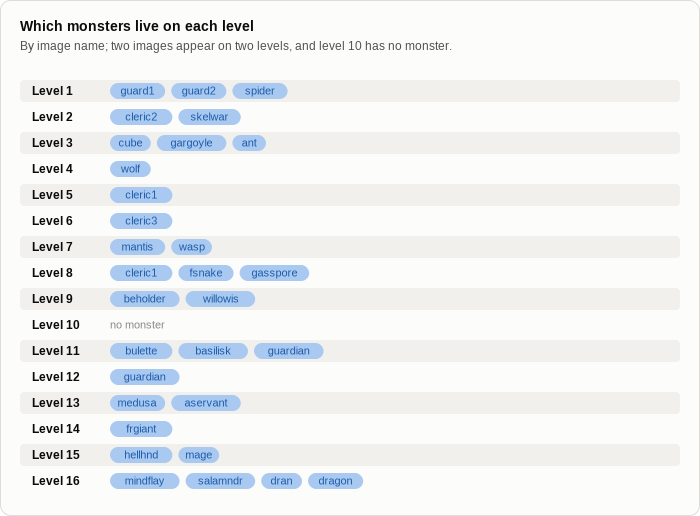
The monsters
One row for each image, in the order of the levels; follow the name to its sheet. The hit points and the experience span all the types drawn with the image; the melee damage is the most that one attack sequence can deal.
| Monster | Levels | Types | Hit points | Melee damage, at most | Experience |
|---|---|---|---|---|---|
guard1 | 1 | 5 | 14–108 | 12 | 650–5,000 |
guard2 | 1 | 3 | 18–108 | 12 | 1,400 |
spider | 1 | 1 | 8–36 | 8 | 650 |
cleric2 | 2 | 3 | 18–99 | 7 | 2,000 |
skelwar | 2 | 1 | 19–82 | 12 | 2,000 |
cube | 3 | 1 | 4–32 | 16 | 975 |
gargoyle | 3 | 1 | 6–48 | 38 | 975 |
ant | 3 | 2 | 2–24 | 8 | 35–175 |
wolf | 4 | 3 | 4–48 | 8 | 65–975 |
cleric1 | 5, 8 | 4 | 8–72 | 16 | 975–2,000 |
cleric3 | 6 | 4 | 9–72 | 16 | 975–3,500 |
mantis | 7 | 3 | 9–51 | 17 | 1,400 |
wasp | 7 | 2 | 18–32 | 32 | 420 |
fsnake | 8 | 4 | 6–34 | 3 | 420 |
gasspore | 8 | 2 | 1 | 1 | 120 |
beholder | 9 | 4 | 61–109 | 16 | 14,000 |
willowis | 9 | 2 | 37–72 | 16 | 3,000 |
bulette | 11 | 1 | 23–72 | 156 | 4,000 |
basilisk | 11 | 1 | 7–49 | 10 | 975 |
guardian | 11, 12 | 3 | 1–80 | 34 | 11,000 |
medusa | 13 | 1 | 6–48 | 4 | 2,000 |
aservant | 13 | 1 | 16–128 | 32 | 10,000 |
frgiant | 14 | 1 | 81–116 | 29 | 7,000 |
hellhnd | 15 | 2 | 5–40 | 5 | 425 |
mage | 15 | 4 | 18–60 | 5 | 4,000–5,500 |
mindflay | 16 | 1 | 61–68 | 40 | 8,000 |
salamndr | 16 | 1 | 48–55 | 26 | 2,000 |
dran | 16 | 1 | 93 | 9 | 11,000 |
dragon | 16 | 1 | 93 | 110 | 12,000 |
One image, several sets of values
An image has no values of its own: they belong to the type that a level draws with it. Only two images appear on more than one level, and neither keeps its values:
guardianhas 3d8 + 56 hit points on level 11 and 10d8 on level 12. Its other values are the same on both levels, and level 12 adds a much weaker type with the same image.cleric1on level 5 has 8d8 + 8 hit points, gives 2,000 experience, opens doors and can be held by Hold Person. On level 8 it has 8d8 hit points, gives 975 experience, has no capability and cannot be held, and it has four ranged attacks.
Within one level, an image often covers several types with different values:
five for guard1, four each for beholder, cleric3, fsnake and mage.
So a sheet has one row of values for each distinct set of values, with the
level and the type numbers that use it: 57 rows for the 63 types. Types that
differ only in the decorations drawn over the image share a row. The two
identical in every field are types 0 and 1 of level 4.
Reading a sheet
A sheet has one row for each distinct set of values; the field names are
those of the INF schema, monster_type_entry.
The summary of a sheet says what the first frame of its image shows. The long form of a shortened name, in parentheses, is a reading of that name (inferred). A monster can appear in three colours, according to its slot, with decorations drawn over it. Level 10 has no monster.
Values:
- Level: the dungeon level, linked to its page. On the six levels with two sublevel records, the record that defines the type. The types of record 1 apply only while that record is current.
- Types: the type numbers in that record.
- Armour class (
armor_class): used by a character's hit roll. The lower it is, the harder the monster is to hit. - Hit chance (
hit_chance): used by a monster's hit roll. The lower it is, the more often the monster hits. - Save level (
level): the level of its saving throws, unrelated to the dungeon level. - Hit points (
hit_points_dice): rolled once for each new monster, as dice plus a bonus. A plain number has no dice. - Melee damage (
damage_dice): one entry for each of its melee attacks, so three entries meanattacks_per_round3. Each attack that hits adds its entry to one total. An entry of 0 still rolls to hit but adds nothing. - Experience (
experience): what the party receives for one kill. - Where it lives gives the monsters on the level at its first arrival,
then the number of
SCRIPT_SPAWN_MONSTERinstructions in its scripts. An instruction can run many times or be refused, so that number does not count monsters. On level 3, the six type 0 instructions of the step script run with either record and count for bothcubeandant.
Abilities:
In the abilities table, capabilities are
MonsterCapabilityFlags without their
MONSTER_CAP_ prefix and immunities are
MonsterImmunityFlags without their
MONSTER_IMMUNE_ prefix.
- Held or turned by (
type_flags): the spells that can affect the type at all; see what each spell does. An immunity or a saving throw can still stop them. - Ranged attacks (
remote_attack_count,remote_weapons): how many each monster has and which weapons it uses, in turn or at random. A spell named here is the spell's flying object; a monster spell has a hit routine of its own.
Other values:
- Occupancy class (
occupancy_class): how monsters share a block. - Attack, step sound (
sound_1,sound_2): the sound numbers that monsters play; −1 plays nothing. - Evasion (
damage_modifier): damage markedMONSTER_DAMAGE_MAGICis cancelled when 1d100 is below it; see damage to a monster. - Decoration groups (
decoration_indices): the DCR groups drawn over the image.
Turn resistance (turn_resistance) is −1 on every type but skelwar, which
has 8; it is the only type that
Turn undead can affect.
- Turn resistance (
turn_resistance): −1 on every type butskelwar, which has 8; it is the only type that Turn undead can affect.
Positions are written [XX:YY]: column XX and row YY, both counted from
00, for block YY × 32 + XX.
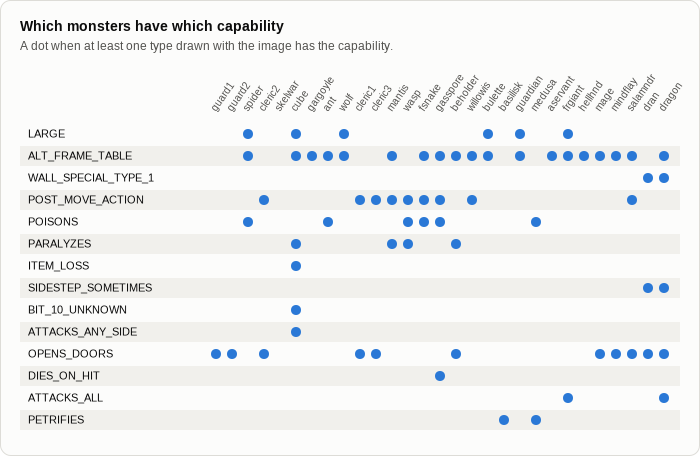
Who has which capability
MonsterCapabilityFlags defines each
value; the rule says how the game uses it. MONSTER_CAP_BIT_6_UNKNOWN and
MONSTER_CAP_HIDDEN are on no type.
Who has which immunity
MonsterImmunityFlags defines each value
and links to the rules. Here guardian means every type of
that image but type 1 of level 12. MONSTER_IMMUNE_PARALYSIS,
MONSTER_IMMUNE_WEAPON_HALVED, MONSTER_IMMUNE_UNKNOWN_0040 and
MONSTER_IMMUNE_UNKNOWN_0400 are on no type.
| Immunity | Monsters |
|---|---|
MONSTER_IMMUNE_BIT_0_UNKNOWN | guardian, dran, dragon |
MONSTER_IMMUNE_FEAR | guardian |
MONSTER_IMMUNE_DEATH | dran, dragon |
MONSTER_IMMUNE_MAGIC | dran, dragon |
MONSTER_IMMUNE_ELECTRICITY | guardian, dran, dragon |
MONSTER_IMMUNE_COLD | guardian, frgiant, dran, dragon |
MONSTER_IMMUNE_NEEDS_MAGIC_WEAPON | gargoyle, aservant, salamndr |
MONSTER_IMMUNE_FIRE | hellhnd (type 0), salamndr, dran, dragon |
MONSTER_IMMUNE_NEEDS_PLUS_TWO | guardian, dran, dragon |
MONSTER_IMMUNE_WEAPON_REDUCED | dran, dragon |
Monsters that need a script or a second record
Positions are written [XX:YY]: column XX and row YY, both counted from 00, for block YY × 32 + XX.
Levels 2 and 16 start with no monster: all of theirs come from scripts. On the other levels, a type that a sheet does not place at the start gets its monsters the same way, when it has any.
A second sublevel record names other images and rewrites some types; see
levels with a second sublevel record.
The monsters already on the level stay in their slots: while that record is
current they take its values and images by type and bank number, and keep the
hit points and the ranged attacks they had, as described under
sublevels. The sheets of the monsters concerned say where they come from:
spider, ant, wasp, cleric1, guardian, dran, dragon.
Three types are defined and used by no monster, at the start or in a script:
type 1 of level 5, type 1 of
level 6 and type 1 of
level 15. With no monster, type
1 of level 15 has no image; its hellhnd row follows from its values, the same
as type 0 but for one immunity (inferred).
Notable values
- Experience does not always follow strength. Type 3 of
guard1gives 5,000 for the same fighting values as type 1, which gives 1,400. Type 2 ofcleric3gives 975 for the same values as type 0, which gives 2,000. Type 1 ofguardianon level 12, with 1d4 hit points and one attack of 1d4, gives 11,000, like type 0. - Some attacks have no dice: the second of types 1 to 4 of
guard1, the second and third ofmindflay. The third attack ofsalamndris a fixed 4. bulettehas the largest melee damage, 4d12, 3d18 and 3d18, at most 156 in one sequence.dragonreaches 110 andmindflay40.- Hit chance need not follow level: type 2 of
magehas 19 and type 3, of the same save level, 10. beholderhas save level 4 and the highest experience, 14,000.- Seven types have fixed hit points:
cleric3type 3 (70),mantistype 2 (51),fsnaketype 3 (34), both types ofgasspore(1),dran(93) anddragon(93). cubemakes no step sound, andcleric1on level 8 makes neither sound.aservantselects decoration group 1, but its image has no DCR file, so nothing is drawn.- Level 14 has one type and no placement by script: 25
frgiantat the start. - Five initial records of level 6, all of type 0, name block 0. The game leaves their slots empty, so they are not counted in the Placed column of values of each type.
Sources
The values were read with the INF schema from the
monster types, monster graphics and initial monsters of the 16 INF files of the
file inventory, and the placements from the
SCRIPT_SPAWN_MONSTER
instructions of their scripts; the sheets and their figures are generated by
make_bestiary.py. The level
pages give each type in context. The descriptions come from the first frame of
each image, cut with its layout, in the
palette of a level that loads it.
In the executable: read monster properties into the monster type properties, the monster graphics slots, the initial monster block, initialize a monster slot, which leaves a slot empty for block 0, and spawn a monster.